Technology and its use are fascinating aspects of society to me, and it’s one of the reasons I decided to put effort into learning the written language to begin with. There are various ways of developing an understanding how people think (archaeology, anthropology, etc.), but it’s the study of their language that provides it in its most direct and intimate form.
Drowning Before You Set Foot Off the Pier

For your average person who takes an interest in anything, the internet is their first, and sometimes only, foray into information on the subject. This can be a wonderful thing, because of the access to tools and study materials, but it’s that access to everything that can be a pernicious influence on learning. Self-study can be a good thing and everyone has to start somewhere, but some things need to be considered and accounted for:
How do I tell what information is accurate?
What are the proper tools for beginners to utilize?
If I’m teaching myself, how do I map my progress?
Are there things I’m missing in my self-study?
What do I do about properly assessing quality control?
If you’re coming directly off the street, so to speak, and trying to engage something as complex and nuanced as a pictographic writing system, you’re already fighting an uphill battle. I know this from personal experience, and that experience is a part of what I’m talking about in this article. This isn’t as much an effort to disparage people for not getting under a teacher, as much as it is demonstrating the issues it causes and how to alleviate them.
How to Mess it Up, Off the Rip
I first tried to study on my own by buying the first edition of James P. Allen’s Middle Egyptian: An Introduction to the Language and Culture of Hieroglyphs when I was in college. The book itself wasn’t the problem, as it’s written for both students in formal classes and self-study. Over the years I stopped and started over several times, due to personal challenges and general life stuff, so I didn’t make much progress.
Once I got to the point that I was able to tell myself, “Okay, I’m going to do this, and I’m not stopping this time,” I ran into another issue…I couldn’t find Allen’s grammar book I bought all those years ago. I didn’t want to buy another one because I bought that one brand new and it was around $80, but even used ones at that time were going for close to $100 online (we won’t mention Gardiner’s grammar book from the early 1960’s, as that one was listed for as much as $700 at one point).
What was I to do?
The wrong thing, that’s what.
The one good thing that came out of losing that book was that it forced me to look into other types of resources a person would need in order to do this properly, because I sure didn’t think about that at all the first go-round. I ended up getting a sign list, a dictionary and a glyphary produced by Bill Petty’s Museum Tours Press. Since I didn’t have the grammar book, but I did have these other resources, it would be a good idea to look up any other resources I’d need to get a good start. If you think I actually did that, you have another think coming because of course I didn’t!
Petty’s books are designed not only for studying in a class setting, but also for going into museums and examining primary documents, and they’re excellent resources for the latter task, especially the glyphary and sign list. Knowing that, what do you think I did? I’ll give you three guesses, but you’ll only need one.
An Introduction Into “Guerrilla Translating”
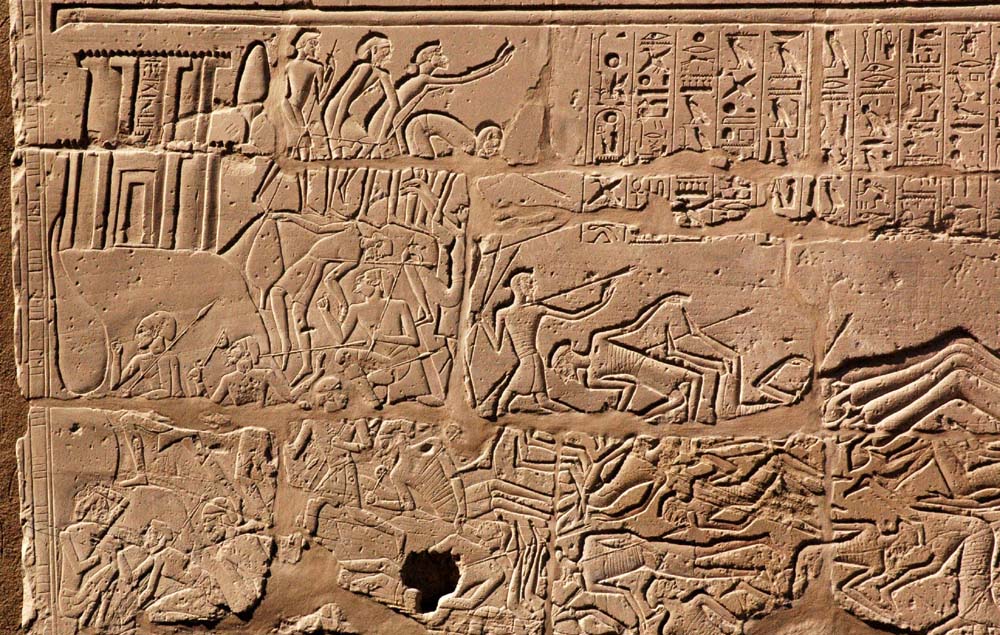
I went to the Virginia Museum of Fine Arts (VMFA for short) with my satchel full of resources I was about to abuse, and went to work, if that’s what you want to call it. Instead of walking you through the whole process, I’ll just bullet point the main components of what I call guerrilla translating:
- walk up to a primary relief like you know what you’re doing
- try to identify the words on the primary, then find them in the dictionary
- bypass learning transliteration, so you have no clue on how to find the words in the dictionary that way so you have to basically look for the individual signs in sequence (for EVERY word on the relief)
- no idea on what the writing from each period looks like, or the standardization to expect? Nooo problem! © Theo Huxtable
- grammar construction? what’s a grammar construction (I actually found my grammar book by this time, but my approach was 100% all bad so it didn’t do any good to start with)!?
- lacunas don’t matter, why should they you can’t read it anyway so don’t worry about it
- when you finally do find all the words, even if the gloss you created is accurate, having a bunch of words and not having a clue on what to do with them will never succeed in stopping you from trashbagging your efforts
- yes I’m aware there’s too many bullet points, hold on I’m making a point here
I did get better, to my credit. I realized that it was taking me too long to translate even short pieces, and it was all due to not really having a method for what I was doing. It was at that point where I had to make a decision to either stay where I was, abandon my studies, or get under a teacher. I decided the third choice was the best, because I wanted it enough to take whatever hardship I may experience going further. I was able to correct all of the issues I had before enrolling in a class, which I’m sure saved my instructors a lot of headaches.
In Pt. II I’ll tell y’all about what happened when I got in class, and how I paid for the whole guerrilla translating thing.
 Old Kingdom Words
Leave a comment